The Accounting Equation
The Accounting Equation and Debits & Credits: The Foundation of Financial Accounting
Accounting can seem complex, but at its core, it revolves around a few key concepts that help businesses track their financial health. Two of the most fundamental concepts in accounting are the accounting equation and the use of debits and credits. Understanding these concepts is essential for anyone involved in managing or analyzing business finances. In this blog post, we’ll break down the accounting equation and the roles that debits and credits play in keeping a business’s books balanced.
What is the Accounting Equation?
The accounting equation is the backbone of double-entry bookkeeping, the most widely used method for recording financial transactions. The equation represents the relationship between a company’s assets, liabilities, and equity. It states:
Assets = Liabilities + Equity
This simple equation reflects how a company’s resources (assets) are financed—either through borrowing (liabilities) or through investment from owners or shareholders (equity).
Assets: These are the resources owned by the business, such as cash, accounts receivable, inventory, and property.
Liabilities: These represent the company’s obligations to outside parties, like loans, accounts payable, and accrued expenses.
Equity: This is the ownership interest in the company, which can come from the owner’s initial investment and any profits the business has earned over time. It’s also referred to as net worth or shareholders’ equity.
Why is the Accounting Equation Important?
The accounting equation ensures that a company’s financial records are always in balance. In other words, it acts as a check-and-balance system. Every transaction a company records will affect at least two of these accounts, and the equation must always stay in balance.
For example, if a business borrows money (increasing its liabilities), it must either spend that money on an asset (like equipment) or add it to the equity of the business (through an owner's contribution). This way, the fundamental relationship between assets, liabilities, and equity is preserved.
Debits and Credits: The Mechanics Behind the Accounting Equation
In accounting, every transaction is recorded using two parts: debits and credits. These two terms can be confusing at first, but once you understand the logic behind them, they’re easy to grasp. Debits and credits help maintain the balance in the accounting equation.
Important to remember: Bookkeeping is a financial story told from the perspective of the business, not the owner.
What Are Debits?
A debit is an entry recorded on the left side of a ledger. In accounting, debits increase asset accounts and decrease liability and equity accounts.
Assets: When you debit an asset account, you are increasing the balance of that asset. For example, when a business buys equipment with cash, you debit the equipment (an asset), and the cash account (another asset) is credited.
Liabilities: When you debit a liability account, you reduce the amount owed by the business. For example, when a business repays a portion of a loan, you debit the loan payable (liability) account.
Equity: Debiting equity accounts decreases the value of the owner’s equity. For example, if an owner takes a draw from the business, the equity is debited (reduced).
What Are Credits?
A credit is an entry recorded on the right side of a ledger. In accounting, credits decrease asset accounts and increase liability and equity accounts.
Assets: When you credit an asset account, you decrease the value of that asset. For example, if a business pays off a portion of its equipment with cash, the cash account (asset) is credited.
Liabilities: When you credit a liability account, you increase the amount owed by the business. For example, when a business borrows money from a bank, it credits the loan payable account (liability).
Equity: Credit entries in equity accounts increase the business’s equity. This happens when the company earns revenue or when new owners contribute more capital to the business.
The Rules for Debits and Credits
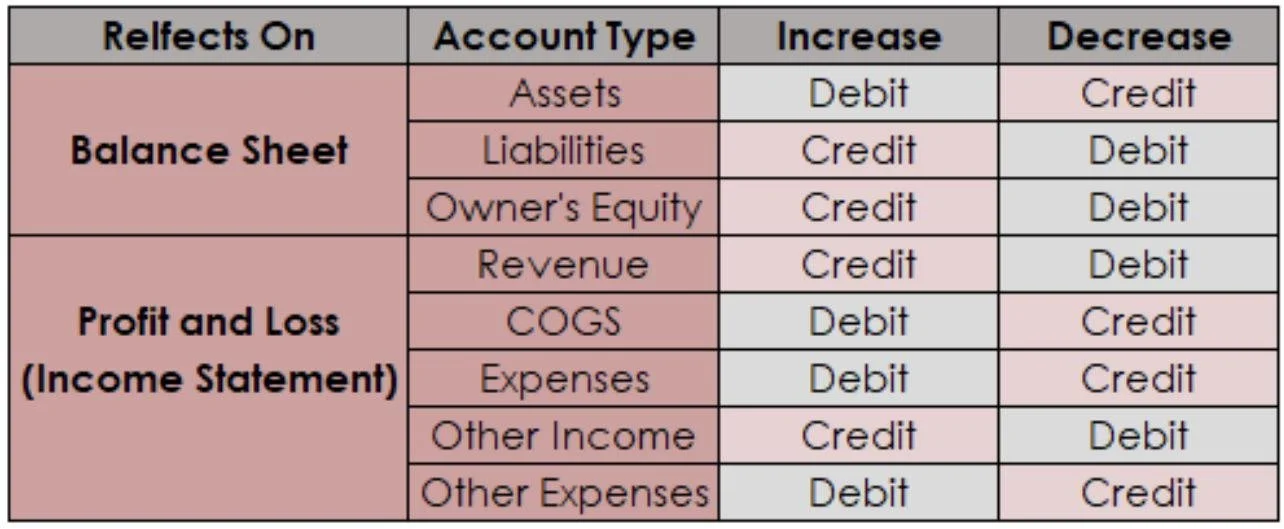
Understanding how debits and credits affect different types of accounts is crucial for maintaining balance in the accounting equation. Here's a breakdown of the basic rules:
Account Type Debit Credit Assets Increase Decrease Liabilities Decrease Increase Equity Decrease Increase Revenue Decrease Increase Expenses Increase Decrease
Assets increase with debits and decrease with credits.
Liabilities and Equity increase with credits and decrease with debits.
Revenue accounts increase with credits and decrease with debits.
Expenses accounts increase with debits and decrease with credits.
An Example of Debits and Credits in Action
Let’s say your business sells a product for $1,000 in cash. Here’s how this transaction would be recorded using debits and credits:
Cash (Asset) increases by $1,000, so we debit the cash account.
Revenue (Equity) increases by $1,000, so we credit the revenue account.
The journal entry for this transaction would look like this:
Account Debit Credit Cash $1,000 Revenue $1,000
This keeps the accounting equation balanced:
Assets = Liabilities + Equity
$1,000 (Cash) = $0 (Liabilities) + $1,000 (Revenue, which affects equity)
Why the Accounting Equation and Debits & Credits Matter
The relationship between the accounting equation and debits and credits is the foundation of accurate financial reporting. By ensuring that every transaction is properly recorded with both a debit and a credit, accountants can maintain the integrity of financial records.
This helps businesses:
Maintain Accurate Financial Statements: Properly recording debits and credits ensures that the financial statements, including the balance sheet and income statement, reflect the true state of the business.
Ensure Financial Balance: By adhering to the accounting equation, businesses can confirm that their books remain balanced, which is essential for compliance and accuracy.
Track Business Performance: Debits and credits provide detailed insights into a company’s financial activity, helping management make informed decisions about growth, profitability, and cash flow.
Conclusion
The accounting equation and the principles of debits and credits form the core of financial accounting. They ensure that a company’s financial records are balanced and provide an accurate reflection of its financial position. Understanding how assets, liabilities, and equity relate to one another—and how transactions are recorded using debits and credits—is essential for anyone working in or studying accounting.
By mastering these fundamental concepts, you’ll have a solid foundation for navigating the world of accounting and making more informed decisions for your business. Whether you’re managing your company’s finances or reviewing financial statements, the accounting equation and the system of debits and credits will help you keep everything in order.